The Rupununi’s Big Farm Already Exists.
Siting, ownership, and processing now decide everything.
Santa Fe has settled whether farming can scale.
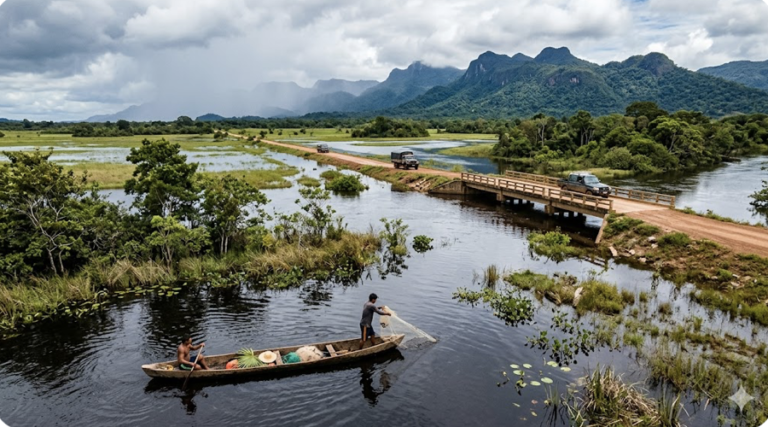
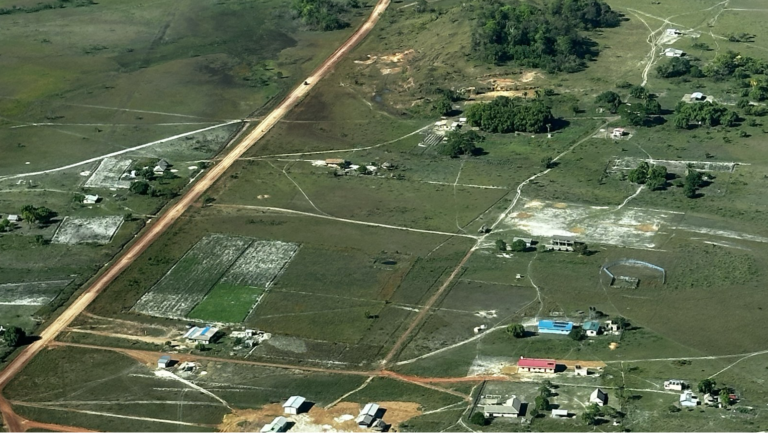
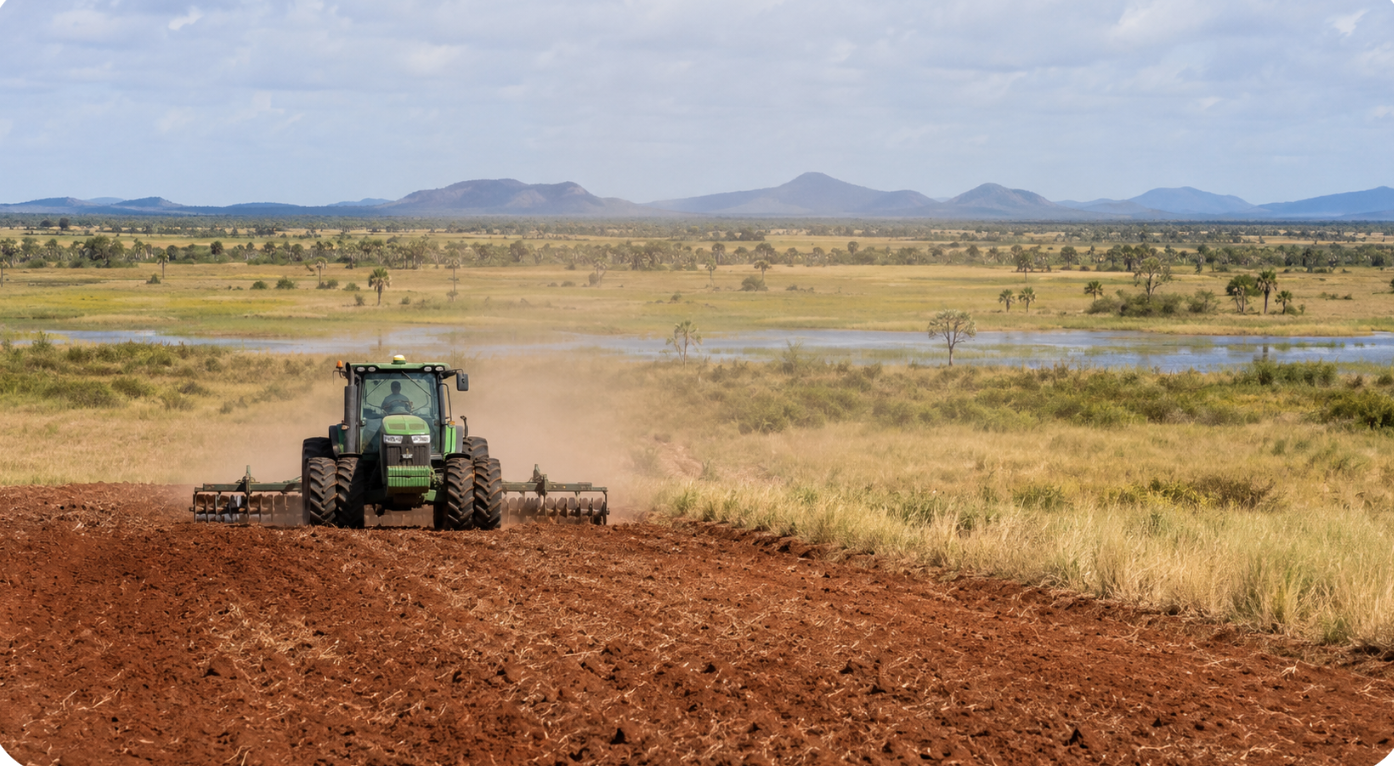
In the North Rupununi, a single large, mechanized farm operates on an 11,700-hectare (29,000-acre) lease, has prepared 3,200 hectares (8,000 acres) for rice cultivation, exported more than 12,000 tons of paddy rice to Brazil, and has expanded into soy and corn production. The central agricultural question facing Region 9 is therefore not whether large-scale agriculture should arrive. It is already here. The real questions are: Which scale? Sited where? Controlled by whom?
A second perspective sits at the other end of the scale. In Quiko, a satellite community of Shulinab, women funded through the Low Carbon Development Strategy (LCDS) carbon-credit revenues supply catering services to kitchens in Lethem, while a community farm produces vegetables for local markets. One image is the 11,700-hectare commercial operation. The other is a community-scale agricultural enterprise. How the Rupununi connects these two realities, rather than choosing one and rejecting the other, will determine the future of Rupununi agriculture.
Two government commitments meet one landscape.
That matters because two critical state commitments meet in the same landscape. On one side sits the LCDS 2030, built around Indigenous participation, community development, and ecological stewardship. On the other hand, the government’s plan for a National Food Hub in Region 9, announced in July 2025, is tied to deeper economic integration with northern Brazil. The policy conversation often presents these as competing visions. They need not be. The choice is not growth versus sustainability. It is a choice about how agriculture is designed.
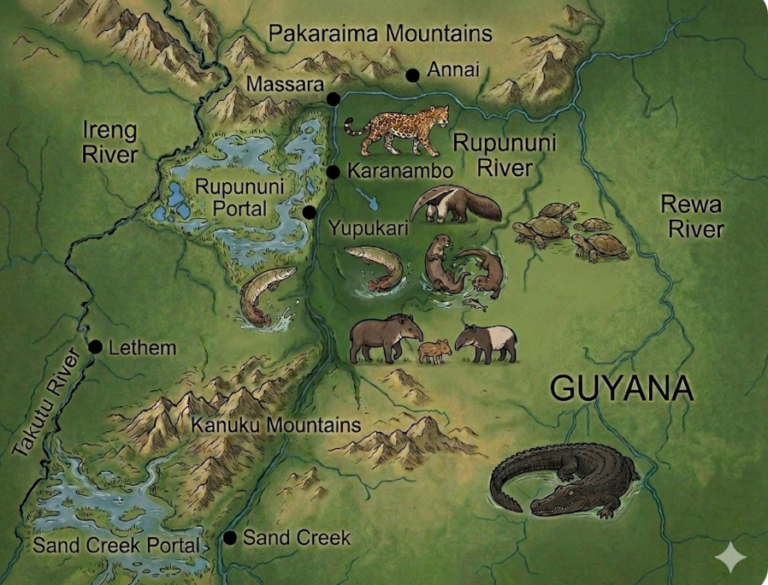
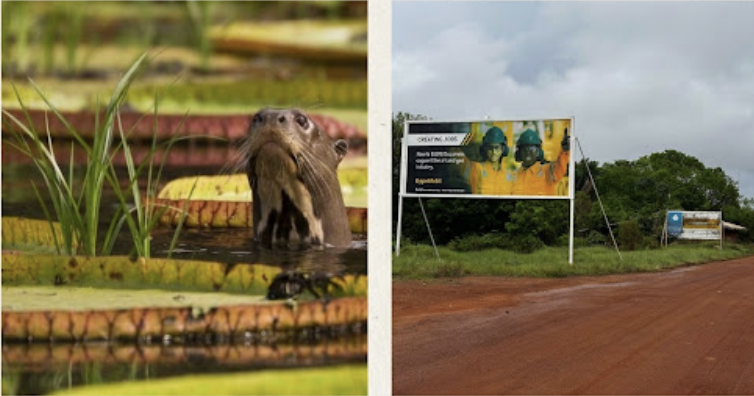
A third use of the same landscape sharpens the stakes. The Rupununi already supports a premium wildlife-ecotourism economy—operators at Karanambu, Surama, Rewa, Caiman House, Dadanawa, and Wichabai sell access to jaguar, giant anteater, black caiman, and the wildlife of an intact savanna-and-wetland system. That product depends on the same flood-pulse hydrology that sustains fisheries, and it commands a price premium precisely because the landscape remains undeveloped. Agriculture and the food hub are, therefore, not the only economies competing for the floodplain. Ecotourism is a second, and the two interactions—agriculture against fisheries, and agriculture against ecotourism—run through the same water and the same land.
Three arguments follow. First, the decisive variable is not the size of the farm but the type, siting, and control. Second, the mid-scale that is crucial to integration already exists in the Rupununi but remains underdeveloped, and the evidence suggests it succeeds only when communities and locals own it. Third, processing, rather than production, is the binding constraint on value capture. Under current trade rules and productive capacities, much of the payoff from processing could accrue to Brazilian producers through throughput rather than to local supply.
Type, siting, and control outweigh the size challenge.
The usual debate on Rupununi agriculture begins with farm size. That is the wrong starting point. The ecological constraint in the Rupununi is not simply that soils are poor. The region’s flood-pulse system actively contributes nutrients and organic material to the landscape. Seasonal inundation deposits nitrogen, phosphorus, potassium, and organic carbon across savanna systems that are otherwise characterized by highly acidic, aluminum-rich soils. Uniform monoculture, therefore, requires replacing ecological functions with purchased inputs. A large farm can use lime, fertilizer, drainage, embankments, and machinery to compensate for soil conditions. The question is not whether this can be done. It can. Santa Fe demonstrates that. The question is what must be altered to make it possible.
Purchased inputs push costs onto the basin.
The inputs that make it possible carry their own ecological cost, and that cost lands on the basin rather than the farm. Heavy fertilizer use on flat, seasonally flooded savanna does not stay where it is applied: runoff carries nutrients into the freshwater wetlands that the flood pulse connects, and contamination at the source travels the whole system. Water demand is the second pressure. Mechanized production during the dry season requires stored water, which is why irrigation reservoirs and dams are located near large farms. But damming creeks for agricultural storage can permanently inundate savanna and block the channels fish use to spawn, altering the flood footprint the entire basin depends on. These are not side effects to be managed after the fact. They are the mechanism by which a single farm’s inputs become everyone’s externality.
There are distinct agricultural solutions to the nutrition problem already in place. Indigenous farmers have long used “caiçaras”: temporary cattle corrals where manure accumulates before cropping begins. This low-input practice enriches nutrient-poor savanna soils without dependence on industrial fertilizer. It is important not because it replaces an industrial-fertilizer approach to commercial farming, but because it bridges the gap between subsistence production and large-scale agriculture. The Rupununi already has a locally adapted soil management technology.
An unmapped flood pulse constrains siting.
Flat savanna areas can support mechanized production where flooding is absent or manageable. Unfortunately, the wet-season inundation envelope in the Rupununi remains incompletely mapped. We know some areas can be mechanized. We do not yet know precisely which areas fall outside the flood pulse and its extremes and which are integral to seasonal hydrological connectivity – even though this is very likely to be local traditional ecological knowledge. Until that map exists, confident claims about where large-scale expansion should occur exceed the available evidence.
Land use control is a contested political settlement.
The debate is often framed as a legal question of ownership. Control is a clearly contested political settlement. The government offers a zero-corporate-tax regime for interior agricultural investment and retains the ability to allocate significant areas of untitled land. Those arrangements favor outside capital. At the same time, village councils and indigenous organizations seek expanded titling and stronger authority over customary territories – precisely to defend traditional land uses. The question is not simply who owns the land. It is whose interests shape critical decisions about conversion, investment, and scale.
These challenges also explain the limits of money. Capital can engineer around soil chemistry. It cannot privatize basin-scale flood connectivity. The fisheries that provide much of the region’s protein depend on ecological connections extending far beyond any individual farm. The same is true of the ecotourism economy: the wildlife and intact landscape it sells are basin-scale assets that no single farm can own or recreate, and that conversion at the margin can quietly erode. The limit is not on yield. The limit is on the externalities the basin can absorb—measured not only by lost protein but also by degraded tourism product.
Seen through this lens, Santa Fe is not evidence that size wins the argument. Santa Fe has already passed the size test. It becomes the test case for the more important questions: sited by whom, on which floodplain, and under whose consent. Those are the variables that determine whether expansion is compatible with the landscape in which it operates.
The middle forms only under community ownership.
The most important layer of Rupununi agriculture is neither the subsistence plot nor the mega-farm. It is the middle ground between these two extremes.
Between village farms and large commercial operations sits a coordinated layer of producer associations, ranch-and-crop integration, shared logistics, cold-chain infrastructure, processing facilities, and collective marketing. These are key value chains where local young people can find employment beyond subsistence production or laboring, and where productivity gains become large enough to matter economically. This layer is the point at which agricultural transformation occurs.
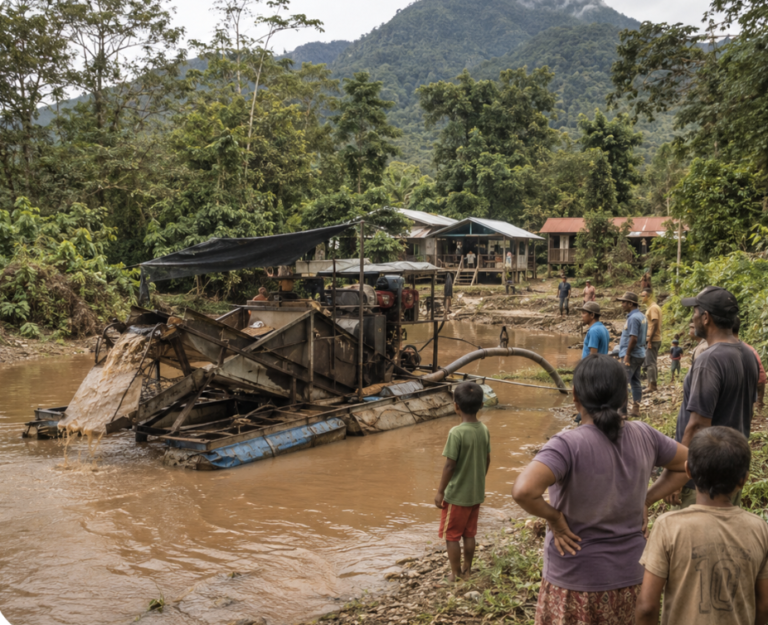
The distinction is not only economic but developmental. A mechanized mega-farm can be highly productive while offering locals little more than seasonal wage labor—jobs that generate income but transfer no ownership, no decision-making, and few transferable skills. In this respect, it differs little from gold mining. When the machinery and the management belong elsewhere, so does the development. The middle layer matters precisely because it changes what local participation means: from laboring on someone else’s operation to owning, running, and accumulating capability within one’s own.
The economic logic is straightforward. Evidence shows that integrated crop-livestock-forest systems outperform both extensive ranching and monocrop systems, generating higher returns and shorter payback periods. The point is not that every producer should adopt a specific production model. The point is that coordination across activities creates value that isolated producers cannot generate on their own.
Delivery, not specification, is the failure.
It would be wrong, however, to argue that this middle layer has been ignored entirely. The LCDS 2030 allocates a portion of carbon-credit revenues to Village Sustainability Plans. Government food-hub plans explicitly discuss aggregation, processing, cold storage, and support for smallholder producers. Youth-oriented agricultural programs already exist. On paper, many elements of the middle are present.
The problem is not the specification. The problem is delivery. Some organizational forms do deliver. Community-owned enterprises and related local structures in the Rupununi have generated employment, supported women and youth, strengthened business capacity, and sustained production over time. These are development outcomes a wage-labor model does not produce: not just income, but enterprises that locals run, skills that stay in the community, and benefits that accrue to participants rather than to distant owners. The successful cases share a common characteristic. Ownership remains local. Decision-making remains local. Benefits remain visible to participants. The evidence, therefore, points toward ownership form rather than subsidy level as the decisive variable. The middle succeeds when communities own it.
RLPA and Quiko show that the middle exists.
The Rupununi Livestock Producers Association (RLPA), established in 1978 and operating from Lethem, demonstrates that the middle already exists. For decades, it has coordinated ranchers, village herds, and smallholders, provided technical support, and represented producer interests. Yet it has not scaled into the kind of integrated value-chain system envisioned by current policy discussions. RLPA, therefore, proves existence, but not expansion.
Using LCDS resources, the community of Quiko established a cooperative farm, created employment, supplied local markets, and supported additional community enterprises. Quiko does not prove that the entire regional economy can be transformed through community farming. What it proves is more modest and more important: the middle can still form when ownership and incentives align.
Taken together, RLPA and Quiko resolve a question that often confuses the policy debate. The middle is neither hypothetical nor absent. It already exists in partial form. The challenge is not creating it from scratch. The challenge is scaling it through institutional arrangements that communities regard as their own.
Processing binds value capture toward Brazil.
The third argument begins with a different question. Where is value being lost? The answer is straightforward. Much of Rupununi agriculture still depends on selling unprocessed products, including live cattle. As a result, substantial value leaves the region before processing, storage, packaging, or distribution occurs. The issue is not merely production. It is what happens after production.
Dadanawa Ranch provides the clearest example. Historically one of the best-known cattle operations in the Rupununi, the company reported losses approaching G$26 million in 2021 and identified two major constraints: cattle rustling and the absence of an internationally certified abattoir. That second point is central. Without certified processing capacity, producers are pushed toward low-value sales channels. Live export becomes the default option not because it is necessarily the most profitable pathway, but because alternatives do not exist.
Under this analysis, processing emerges as the binding constraint. No internationally certified abattoir currently operates in the Rupununi. As long as that remains true, live export remains structurally favored. Processing capacity, therefore, becomes more consequential than additional production acreage. More cattle alone do not solve the problem. Processing capacity changes where value is captured.
The food hub’s value is connection.
The proposed food hub matters for the same reason. Its primary economic return comes not from converting more land into production but from connecting dispersed producers through aggregation, storage, cold chains, processing facilities, and cross-border logistics. The value lies in connection. A food hub built solely to manage a production zone overlooks the very mechanism by which value is generated.
A specific trade rule drives the issue of the abattoir. For Brazilian beef to enter Caribbean Community (CARICOM) markets with preferential treatment, substantial transformation must occur inside Guyana. Processing is therefore not simply a manufacturing activity. It is the legal instrument through which a producer creates and captures additional value. That is the mechanism linking the hub to regional trade.
On beef, the payoff tilts to Brazil.
Here, the argument turns. The scale differential between Guyana and Brazil is enormous. Brazil produces roughly 10 million tons of beef annually compared with approximately 2,900 tons in Guyana. The gap is not abstract: Vice President Bharrat Jagdeo has noted that a sustained attempt to export local cattle would deplete Guyana’s entire herd within a month, and the government is designing the Lethem cold-storage facilities to process meat moving across the border from Roraima. A certified beef abattoir at Lethem would therefore run mostly on Brazilian throughput, not Rupununi cattle, because the local herd cannot feed it. The processing opportunity is real, but on beef, much of its payoff attaches to goods arriving from Roraima rather than to products originating in the Rupununi itself.
The importance of processing does not mean that production is not important. Santa Fe serves as the counter-test. It is a vertically integrated operation that exports directly and demonstrates that production can generate value under certain conditions. The conclusion is narrower: value becomes stranded where processing is absent, not where production exists. Processing is the binding constraint, but not the only one.
Local advantage lies in niche products.
A sharper point is about which products. The case for local processing is weakest exactly where Guyana would be competing head-on with Brazil—beef, soy, and rice—because there, the scale differential determines the outcome, and the throughput defaults to Roraima. It is strongest where the Rupununi holds a comparative advantage that Brazil does not contest. The region structurally favors diversified, adaptive, mosaic agriculture over uniform monoculture, and its plausible value-capture lies in products tied to that landscape: bitter cassava and its derivatives, peanut processing of the kind that already supplies cottage industries, and wild honey as a non-timber forest product that earns export value without land conversion. The lesson is not that the Rupununi should build a beef abattoir to out-process Brazil. It is that processing pays locally when it is matched to what the Rupununi can supply better than its giant neighbor.
The three arguments pull against each other.
The three arguments reinforce one another, but they do not fit together neatly. The first tension sits between ecological siting and logistical scale.
Siting must govern agricultural expansion because the flood pulse imposes real ecological constraints. Value capture depends on building larger logistical systems: aggregation points, cold storage, processing facilities, and cross-border transport links. The tension is obvious. The same corridor that captures value can also intensify pressure on the flood-pulse landscape. The infrastructure that makes processing possible may increase the very development pressures that make siting important.
The second tension sits between community ownership and land tenure. The evidence suggests that the middle succeeds when communities own the institutions, assets, and enterprises involved. But control remains contested. Significant areas remain untitled indigenous lands. Existing titles contain exceptions and overlaps. Communities cannot confidently invest in processing facilities, aggregation systems, or cooperative enterprises if authority over land remains uncertain. Enterprise ownership is closely linked to territorial ownership.
The outside brings two more tensions.
The third tension sits between local value capture and Brazilian throughput. You can strengthen local value chains. But the hub’s economic logic may depend heavily on Brazilian product flows. Those two objectives are not necessarily incompatible, but they are not identical either. A hub can process large volumes and still leave local producers on the margins. The risk is that Roraima’s throughput arrives before Rupununi’s value chains mature. In that scenario, the hub succeeds as a logistics platform while failing as a local development strategy.
The fourth tension sits between agricultural expansion and the ecotourism economy. Both depend on the flood-pulse landscape, but each activity monetizes it in opposite ways. Agriculture and the hub capture value by converting land and building a logistics corridor through it. Ecotourism captures value by keeping the landscape intact and selling its scarcity—rare wildlife, remoteness, and an undeveloped basin. The Georgetown-Lethem Road is the shared trigger: the same upgrade that extends agriculture’s reach and feeds the hub also brings the visitor volume, settlement spillover, and land pressure that degrade the tourism product. Conversion, drainage, and traffic that raise agricultural value can lower the premium that ecotourism depends on. The two are not necessarily incompatible, but they pull on the same asset, and unmanaged agricultural growth can strand the tourism economy as surely as the absence of processing strands agricultural value.
These tensions point to a sequencing problem. The single investment that contributes directly to development is not another production mega-farm. Investment in a local- or community-owned certified abattoir linked to cold-chain infrastructure could be an important step. Such a facility would strengthen local value chains, create a practical destination for aggregation, and address the processing bottleneck that currently strands value. But the ownership condition matters. Without community ownership, the identified processing gains do not necessarily translate into local development outcomes. The ownership condition gates the payoff.
Design, not growth, decides the outcome.
The choice facing the Rupununi is not how much to grow. Santa Fe Farm already settled that debate. Large-scale agriculture exists in Region 9. The more important questions are those that remain unresolved: which scale? sited where? controlled by whom?
One investment answers all three arguments. It is not another production mega-farm. It is a community-owned certified abattoir supported by aggregation systems and cold-chain infrastructure. Such an investment addresses the value-capture problem, strengthens the middle layer, and creates a reason for local producers to participate in coordinated value chains. It also delivers what the government has already committed to: the LCDS 2030’s promise of community development and Indigenous participation, and the Food Hub’s stated aim of empowering smallholder producers. The recommendation is not a departure from current policy. It is the route by which current policy meets its own goals.
That still leaves the most important political-economy question, and it is one the government can decide rather than inherit. If processing capacity expands and Brazilian cattle move through Lethem under substantial-transformation rules, who captures the value? Hub operators, the state, or local producers? Trade rules do not fix the outcome; it is fixed by how the hub is owned and sequenced. The same facility can become a regional-development mechanism or a transit corridor through which value passes. Which one it becomes is a design choice, not an accident.
The oil window is closing on this.
There is a clock on this design question. The importance is structural. Guyana’s oil revenues are large but finite, and an economy that relies on them to substitute for a lack of productive capacity will face a hard adjustment when they decline. For analysis of Guyana’s oil boom and its fiscal and institutional implications, see Guyana’s Oil Boom 2015 to Today at Watkins Advisory. The Rupununi’s agriculture, processing, and ecotourism are the kind of tradable, locally owned sectors that can outlast the oil—but only if they are built. At the same time, there is still public money to seed them. The point of the abattoir, the aggregation systems, and the community enterprises is to leave behind a productive base that does not depend on petroleum receipts.
The urgency is that oil works against this build even as it funds it. Large resource revenues tend to strengthen the exchange rate and bid up wages, making non-oil tradables harder to establish—the pattern known as Dutch disease, and a risk the tourism sector already feels as the oil economy raises wage expectations faster than the interior can match. The historical roots of Guyana’s commodity dependence are explored in Guyana 1962–1975: State Control and Commodity Exposure at The Next Wave. The window is therefore double-edged: the same oil money that could finance the middle layer also raises the cost and difficulty of standing it up, and that difficulty grows the longer the build is deferred. The institutions need to be running before the revenue peaks and before appreciation and wage pressure harden against them.
A falsifiable test settles the question.
The government would need to apply its own sequencing. If Lethem’s cold-storage facilities open before community-owned aggregation systems and a certified abattoir are established, then throughput is likely to become predominantly Brazilian re-export rather than Rupununi production during the hub’s early operating years. Sequencing the community-owned capacity first is therefore the difference between the two outcomes. That forecast is falsifiable. Customs data, processing records, and substantial-transformation filings will eventually show whether the hub develops first as a regional logistics platform or as a locally anchored agricultural system.
The future of Rupununi agriculture, therefore, turns on a design question rather than a growth question. That design cannot treat agriculture in isolation. Farming, fisheries, and a premium ecotourism economy all draw on the same flood-pulse landscape, and a road built for one will reshape the others. How the region connects scale, siting, ownership, processing, and logistics into a system that reconciles these competing uses—one that the local community can shape and benefit from—will determine its success far more than how much land enters production. The future will eventually show whether the hub develops first as a regional logistics platform or as a locally anchored agricultural system.
The future of agriculture in the Rupununi, therefore, turns on a design question rather than a growth question. That design cannot treat agriculture in isolation. Farming, fisheries, and a premium ecotourism economy all draw on the same flood-pulse landscape, and a road built for one will reshape the others. How the region connects scale, siting, ownership, processing, and logistics into a system that reconciles these competing uses—one local communities can shape and benefit from—will determine its success far more than how much land enters production.
Explore the Rupununi
Dive deeper into the Rupununi’s natural and human world. Explore the region’s ancient geology and Guiana Shield, the remarkable wildlife of the Rupununi, the rich history of human settlement, and the living culture of the people of the Rupununi. Learn more about the authors behind this companion site, and follow the latest thinking on conservation and development in the Rupununi Blog.
Follow the Rupununi on Facebook for new stories, wildlife news, and updates from the book: facebook.com/rupununi.org
Discover more from Rupununi: Rediscovering a Lost World
Subscribe to get the latest posts sent to your email.