Rupununi gold leaves while its costs stay.
Gold value escapes while communities absorb damage.
In April 2025 and again in June 2026, a government joint enforcement team arrested illegal miners inside the 930,000-acre Iwokrama Forest. Most were Brazilian garimpeiros, wildcat miners who crossed the southern border to dig where gold mining is banned. Iwokrama’s 2024 Annual Report had already reported incursions the year before. Miners had breached the same protected forest for several years in a row.
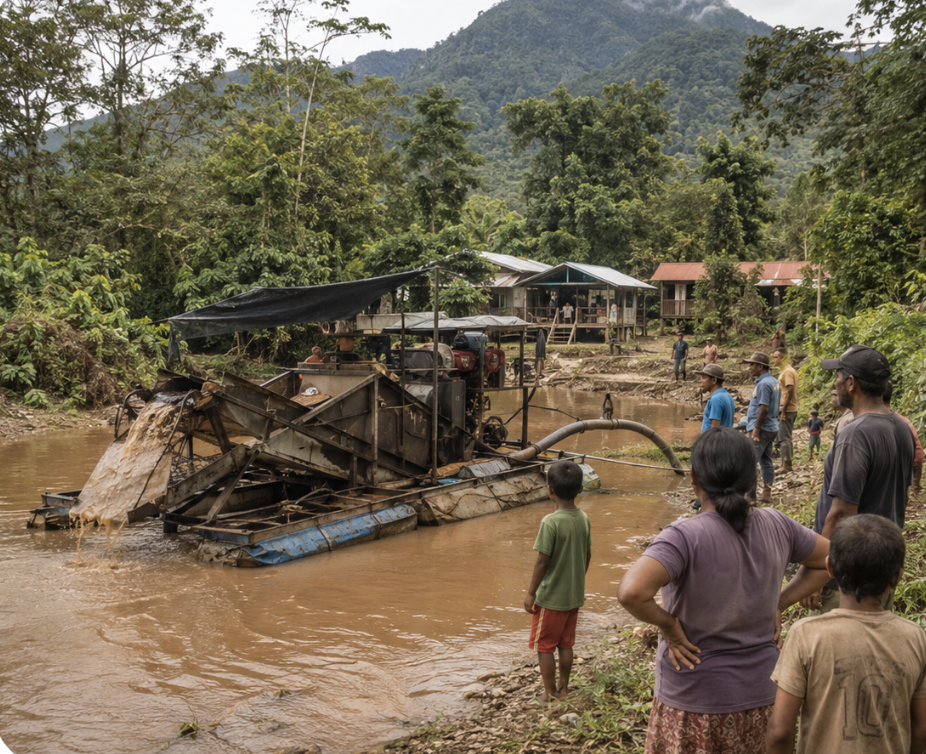
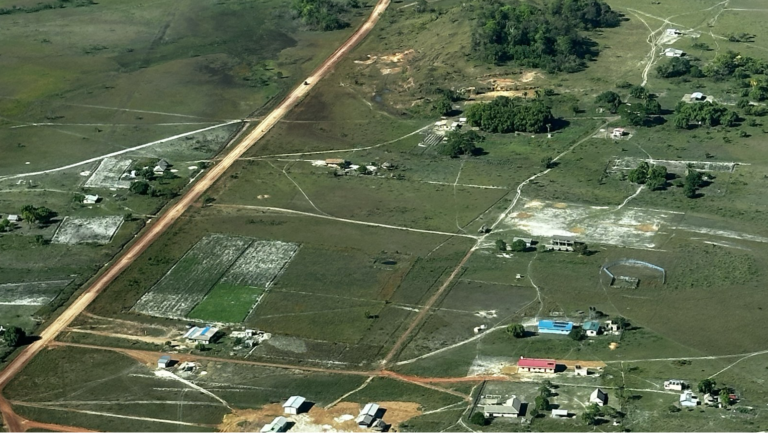
The fuller version of the Rupununi mining economy sits in the south, at Marudi Mountain. Marudi draws the whole problem onto one mountain. Aishalton has claimed title to the land since 1967. Romanex and Golden Shield Resources entered the same ground through mining concessions. Marudi Creek and the Kuyuwini River carry the contamination.
The main question is, when gold is extracted from the Rupununi, who captures the value, and who bears the costs? The answer is not about blame. The reality is that the gold leaves; the costs stay. Local action can fix only one part of that problem. The blog looks at how Rupununi mining value escapes the country, how little to no value reaches local communities, the challenges of control, and how costs stay with the communities, and provides some ideas on how to address these challenges.
Gold mining value escapes before Guyana counts it.
Rupununi forest gold creates real value, but much of it escapes before Guyana can count it. Licensed Guyanese miners and garimpeiros extract alluvial gold at Marudi and inside Iwokrama. They amalgamate the metal in interior camps, then sell it through dealers or carry it across the border. The long border between region 9 and Roraima in Brazil means that gold reaches world markets without leaving a Guyanese receipt.
In 2005, the Guyana Geology and Mines Commission (GGMC) estimated that 30 to 80 percent of annual gold output left the country undeclared. It valued that missing gold at about US$200 million in 2005 prices. Undeclared output had already topped 20 percent a year from 1976 to 1997. In 2015 and 2016, the GGMC and the then Natural Resources Minister Raphael Trotman put weekly smuggling at 15,000 ounces. They valued the loss at up to US$1 billion in a single year.
However, the Rupununi’s own numbers tell a murkier story. District No. 6 is the GGMC’s mining district for the Rupununi, the same southern interior as administrative Region 9. Its declarations fell from 51,226 ounces in 2012 to 195.37 ounces in 2021. But dealers may have booked the 2021 metal under the Licensed Dealers line, which recorded 334,197 ounces. The collapse cannot separate smuggling from gold that dealers simply booked elsewhere.
Marudi is a routing problem. Garimpeiros own up to 17 percent of Guyana’s small- and medium-scale dredges. The April 2025 arrests show foreign crews entering protected forests. No one has a reliable measure of how much Rupununi gold crosses the border.
No royalties or benefits reach local communities.
The costs land in the Rupununi; the payments do not. No named royalty, wage, or benefit reaches Aishalton, Awarewaunau, or the South Rupununi District Council (SRDC). That does not mean there are no payments. Transfers could go undocumented or be recorded at the national level. But nothing on public record shows a working local channel.
The law offers a path that Marudi has never used. The Amerindian Act 2006 recognizes Free, Prior and Informed Consent (FPIC) and the value of benefit-sharing routes for village councils. Romanex proposed community benefits in its 2018 draft Environmental Impact Assessment (EIA). Golden Shield Resources then took a three-year prospecting license on 2 December 2021. The United Nations human rights office (OHCHR) later found the government granted the license without FPIC from Aishalton and Awarewaunau.
Still, communities are not uniformly against mining. In 2021, the Rupununi Miners Association signed an expansion agreement with Aurous Mining and Romanex. Some Rupununi actors want the income. Whether that association speaks for the relevant village councils is unclear.
By contrast, Fair View shows a very different pattern of resource use. The village has held title inside Iwokrama since July 2006. Iwokrama Timber Inc. gave local communities a 24 percent equity stake, and from 2008, a visitor fee funded a Community Fund. About 60 percent of the Iwokrama staff come from local communities. When a local institution holds the value, some of it stays.
Authority and capacity sit in different places.
Costs persist because authority and capacity sit in different places. The SRDC has monitored the South Rupununi since 2013, beginning at Shulinab and logging more than 250 observations through March 2018. Monitors used drones and GeoODK (Open Data Kit) to record georeferenced photos. They worked with New York University (NYU), Digital Democracy, and the Forest Peoples Programme. But the SRDC can neither interdict miners nor collect royalties.
The state has the legal authority, but not the field presence to match the terrain. Iwokrama covers 930,000 acres, with no permanent enforcement presence across the entire forest. Miners can bypass the Kurupukari checkpoint by river and trail. Meanwhile, GGMC enforcement is presently underfunded and insufficient against informal mining. Raids catch people only after miners establish a working site.
Similarly, Marudi repeats the gap at the licensing stage. Aishalton has claimed the mountain since 1967. The Amerindian Act created consent requirements, but no institution has enforced them. Regulators issue mining licenses without the consent the law requires.
The 2024 and 2025 incursions make the capacity gap visible. The state mounts raids, but recurrence shows it cannot sustain deterrence. The SRDC documents violations, but documentation does not stop dredges. Authority, money, and reach must align, and at Marudi, they do not.
Mercury and health costs stay with communities.
Mining leaves a clearer local cost than a local payment. A 2016 assessment found mercury levels of 4.64 micrograms per liter in Marudi Creek and 4.55 micrograms per liter in the Kuyuwini River. Turbidity in Marudi Creek reached 154 nephelometric turbidity units (NTU), a level that fouls fish habitat. SRDC monitoring attributed about half of the recorded impacts to mining.
Both readings fall below the World Health Organization (WHO) drinking-water guideline of 6 micrograms per liter. But the guideline measures the wrong thing. It covers water you drink, not the methylmercury that builds up in the fish people eat. Guyana set the bar higher on paper. It pledged under the Minamata Convention to phase out mercury from mining by 2025, a deadline that has now passed. The monitoring results measure the gap between that pledge and the creek.
The pathway is concrete. Miners add elemental mercury to dredged slurry to amalgamate fine gold, then burn the amalgam in the open or using retorts. The burn releases mercury vapor; the residue settles into the creek sediment. There, sulfate-reducing bacteria convert it into methylmercury, which climbs the food chain. River communities eat the fish as their primary source of protein.
The costs land on people, not the operators.
Watson’s 2020 study found elevated methylmercury in the hair of fish-eating South Rupununi communities. It documents exposure, not a measured clinical outcome. No medical screening, dietary alternative, or compensation reaches the affected villages. The risk is on the record; the payment is not.
The health burden also runs past mercury. Hydraulic pools breed Anopheles mosquitoes, and Heemskerk’s 2021 work shows elevated malaria in mining populations. SRDC monitors also recorded rising sexually transmitted disease (STD) rates and the prostitution of young Wapichan women around the sites. Treatment costs fall on the Ministry of Health and on individuals, not on the operators creating the exposure. Some miners are themselves Indigenous community members. That blurs the line between who profits and who pays, but it does not erase it.
Local tools fix distribution but not leakage.
The Rupununi has two problems, and they should not be collapsed into one. Benefit-sharing and co-management authority can fix local capture and distribution. Village institutions cannot fix cross-border leakage. It runs on gold prices, organized crime, royalty arbitrage, and weak border enforcement.
Co-management and a payment rail exist already.
The local fix has an institutional base. Fair View’s co-management arrangement dates to 2006 and was renewed in January 2023 (see Iwokrama 30 Years On). The SRDC monitoring program has run since 2013, across changes of government. That persistence is the basis on which a benefit-sharing mechanism can build.
Indeed, the model is not rare in the Rupununi. The Kanuku Mountains Protected Area sits in region 9. The Protected Areas Commission runs it with a community group for 21 villages, and the rangers are local. To the north, villages have co-managed land with Iwokrama through a district board since the 1990s. But each of these agreements concerns forest resources, not gold.
Furthermore, a payment channel already exists. Guyana’s carbon-credit sales pay Amerindian villages directly, and Guyana disbursed US$22.5 million to 242 village accounts in 2023 alone. The channel is built, and the councils already hold the funds. Gold pays nothing into it. The fix is to route a gold contribution through the same channel.
Cross-border leakage needs national and regional tools.
The leakage fix needs different instruments. For example, one route is for Guyana to harmonize its royalty rates with those of Brazil and Suriname, thereby removing the arbitrage that drives smuggling. Guyana also sits on a Venezuela-linked transit and laundering corridor tied to organized crime. The SRDC cannot police those channels from Aishalton.
The fixes build on the work the government has already begun. Under the Low Carbon Development Strategy, carbon-credit sales already pay village councils. The Minamata action plan commits the state to cutting mercury mining. For a broader analysis of Guyana’s resource governance challenges, see Guyana’s Oil Boom 2015 to Today: Fast Growth, Hard Choices at Watkins Advisory. The National Forest Restoration Initiative reclaims mined-out land. The vision and ambition exist; delivery has lagged.
In short, each Rupununi problem has an owner and a first step. The GGMC and the Ministry of Natural Resources can pilot a Marudi benefit-share. It would pay into the Village Bank Accounts that already hold carbon money. The GGMC, the Bank of Guyana, and customs can strengthen their capacities at the Lethem crossing. Every ounce recorded there is royalty the treasury now loses. The Ministry of Amerindian Affairs and the National Toshaos Council can secure the FPIC that the Marudi license skipped. The Environmental Protection Agency and the Ministry of Health can screen fish and people at Aishalton and Awarewaunau.
Returning to the April 2025 arrests. The raid was the kind of enforcement that the state cannot sustain everywhere. Marudi is a distribution problem, and no one has built an institution to handle it. The border is a leakage problem that local co-management cannot address. Until benefit-sharing has a holder and leakage falls with funded enforcement, the gold keeps leaving, and the costs keep falling on people who never dug it. See also: Guyana 1962–1975: State Control and Commodity Exposure, which traces how state capacity shaped earlier resource governance in Guyana.
Explore the Rupununi
Dive deeper into the Rupununi’s natural and human world. Explore the region’s ancient geology and Guiana Shield, the remarkable wildlife of the Rupununi, the rich history of human settlement, and the living culture of the people of the Rupununi. Learn more about the authors behind this companion site, and follow the latest thinking on conservation and development in the Rupununi Blog.
Follow the Rupununi on Facebook for new stories, wildlife news, and updates from the book: facebook.com/rupununi.org
Discover more from Rupununi: Rediscovering a Lost World
Subscribe to get the latest posts sent to your email.



One Comment