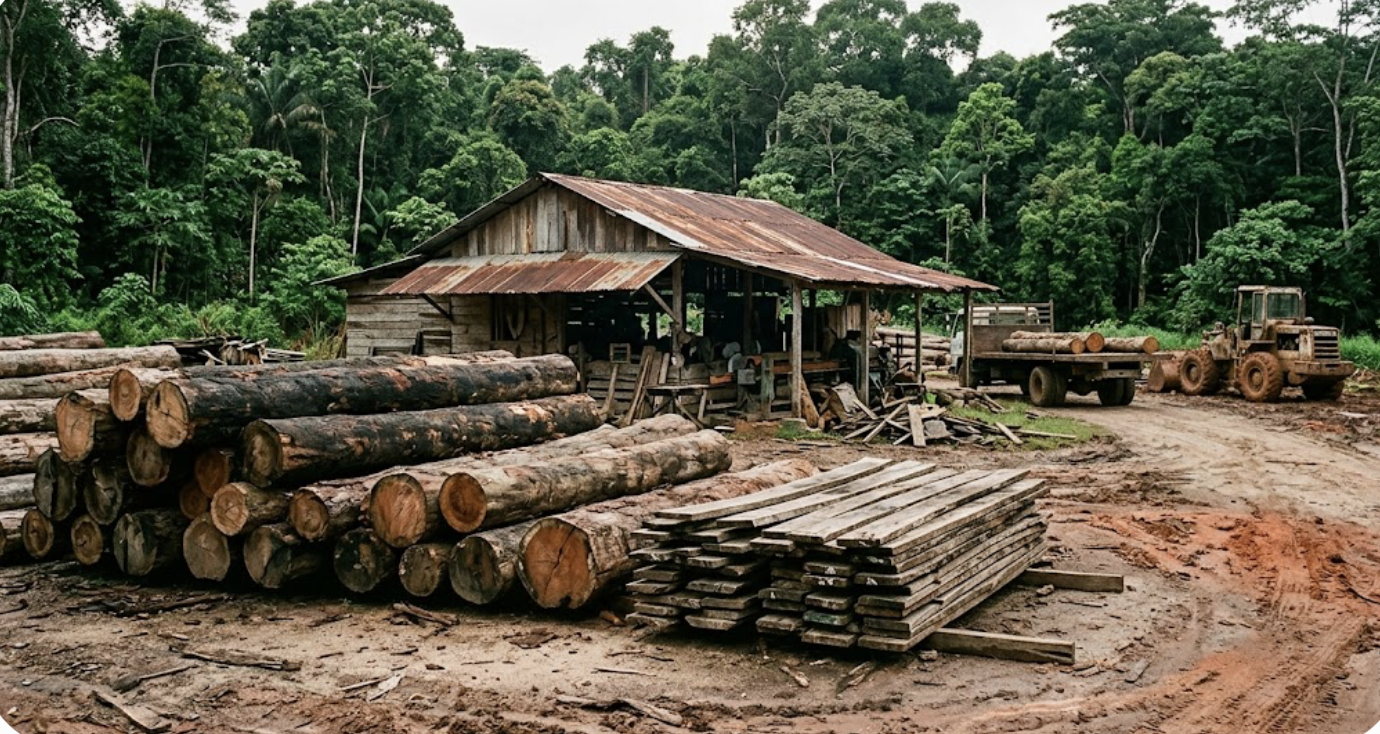
Guyana’s Oil Window Can Build Lasting Forest Businesses.
Why the oil decade is the time to invest in value addition.
In 2000, Guyana exported roughly US$21 million of plywood. By 2022, plywood exports had fallen to a fraction of that value, pushed down by the global financial crisis, the cost of value-chain certification, and softening demand for tropical timber. Over the same period, successive governments held deforestation near the world’s lowest rate. The value-added agenda they set, through processing, manufacturing, and value-added exports, remains the unfinished part of that record.
That gap sits at the center of Guyana’s modern forest story. Forest institutions kept promoting value addition. Policy documents named processing as a national priority. Through the Low Carbon Development Strategy (LCDS), Guyana also became a global early mover in forest carbon finance, keeping its forests standing while advancing the value-added agenda. That carbon finance, and then oil revenue, gave Guyana public capital it did not have before. For the broader economic context of Guyana’s oil transition, see Guyana’s Oil Boom 2015 to Today at Watkins Advisory. The processing base has not yet been followed. Logs took a larger share of output, and several manufacturers exited. The strategy held steady. The means to deliver it have only now arrived.
This blog makes three arguments. First, the sector shifted toward raw output in measurable ways. Second, firms upgraded slowly because the incentives and finance to process were not yet in place. The Guyana Forestry Commission (GFC) can now help close that gap with stronger tools. Third, oil has raised the stakes and the resources. Guyana can now fund durable businesses that outlast the boom, including forest carbon and biodiversity credits, value-added production, and a growing domestic market. Barama runs through all three arguments because it was Guyana’s largest concessionaire and once its main plywood producer.
Global Shocks Drove the Shift to Raw Output.
The first argument concerns outcomes. Before asking why value addition stalled, the blog must show what changed. Raw logs increased their share of timber production, while several higher-value activities stagnated or contracted. Plywood gives the clearest case. Barama’s plywood operation once stood for the industrial model that policymakers wanted. By the early 2020s, plywood exports had largely vanished from Guyana’s export profile.
The pattern went beyond one company. Primary lumber production has declined over time. Precision Woodworking, once a prominent manufacturer of finished wood products, closed. The public record points to a demand shock from the global financial crisis, the need to meet Forest Stewardship Council (FSC) certification requirements across the value chain, and difficulty raising finance for restructuring. Other firms that carried the value-added vision were similarly exposed to weak supply chains and thin finance and contracted or exited.
Domestic Demand Grew as Export Markets Turned.
A market story does not fully explain these results. Export markets changed, but domestic demand also grew. Construction activity in the wider economy has created, and continues to create, new demand for construction timber. At the same time, the wider market for tropical log exports weakened as trade shifted away from raw logs and Chinese demand softened. Barama was increasingly selling to domestic buyers rather than export markets.
That shift matters, but it does not settle the issue. Lower processed exports do not by themselves prove lower economic activity. Domestic absorption explains part of the fall in processed exports. It does not explain why processing capacity has not yet expanded as demand rose.
Liana Cane offers a counterpoint. The company kept producing higher-value products from forest resources. The strategy is built on a distinctive design and a mix of local and export markets. It shows that value addition remained possible in some niches. But niche survival did not turn into sector structure.
The outcome is hard to dispute. Guyana’s forest sector produced more raw output and less large-scale processing than policymakers had planned.
Incentives Have Not Yet Rewarded Processing.
The second argument concerns the mechanism. The problem was not only dependence on log exports. The constraint was alignment, not ambition. For decades, policy documents promoted value addition, and the GFC carried that goal forward. Firms faced market incentives that pointed toward extraction. Closing that gap is a pricing and finance question the government can now act on.
Firms Had Clear Reasons to Export Logs.
The central question is simple: why did firms continue to choose logs over processing? One answer is straightforward. Firms responded to the incentives in front of them. Processing needs capital, technical skill, equipment maintenance, market access, and stable supply chains. Log extraction needs less of each.
Reforms to stumpage fees and other pricing tools have moved slowly. Until pricing rewards processing over extraction, firms have little reason to move up the value chain. The strategy is clear. The work is aligning incentives with it.
Strategy Is Set; Delivery Is the Task.
The legal record is clear on direction. Governments put value addition into strategies, plans, and sector goals. The harder question is implementation. Did agencies enforce processing requirements weakly? Did firms evade them? Or did the state lack the reach to monitor and compel compliance across a dispersed forest estate?
Reforms moved slowly, and implementation lagged behind the strategy. Closing that gap is the work that the oil era can now fund.
Precision Woodworking makes the point. The loss of a value-added manufacturer showed that firms in that space needed support the system was not yet built to give. Filling that gap is the response that the oil era can now provide.
Oil Opens the Window to Build.
The third argument concerns what oil now makes possible. Oil revenue does not remove the forest-sector challenge. It provides the capital to meet it, and the reason to build durable post-oil businesses now.
Among the businesses that could outlast the boom are carbon credits, biodiversity credits, value-added forest production, and sales into a growing national market. Guyana already earns from forest carbon. Scaling the rest is the next execution task.
If the government wants those activities to scale, it must turn intention into vision and plans into reality. That requires public investment that creates markets through procurement, builds capacity for value adding, and addresses the infrastructure constraints that still block processing and market access.
The state must also shape the market. It must attract and guide private investment through incentives that reward value-adding rather than raw extraction. With that alignment, oil revenue can finance the value-added base that earlier strategies could not.
Learning Is the Next Step.
Learning may matter most. A government that wants value addition cannot rely on fixed plans alone. It needs a system of learning and adaptive management that can change course when actions are not producing results.
The record points to the same lesson. The data shows consistent intent and planning that have not yet shifted sector structure. The missing piece may not be another strategy. It may be a state system capable of testing, learning, and adjusting.
Barama matters here as well. Its trajectory shows what happens when a flagship processor declines and no replacement system emerges to rebuild capability, redirect incentives, or solve the constraints that blocked upgrading.
The choice is now plain, and the resources to make it are in hand. Guyana can use the oil window to build competitive forest businesses before the boom fades.
The Hard Question May Be Commercial Viability.
The strongest rival explanation challenges the premise of the debate. What if Guyana’s forests never fit the industrial model that policymakers pursued?
Guyana has a dispersed forest estate, limited domestic scale, high transport costs, and a small public administration. Industrial plywood production, furniture exports, and large-scale manufacturing need reliable volume, infrastructure, specialized skills, and competitive costs. Viability, therefore, does not depend on firms alone. It also depends on whether the state opens private-sector space through targeted national development bank finance. Industrial parks and stockyards also matter. So, capacity building and procurement are aligned with local production. Even the domestic market now demands more standardization and quality than many local producers have consistently delivered. Imported value-added timber products often meet those requirements more reliably.
Some evidence supports that explanation. Processing capacity remained limited. Technical constraints persisted. Some value-added firms disappeared despite decades of policy support.
But this rival explanation also stops short. Barama ran a plywood facility. Liana Cane survived. Non-timber forest products generated value. The sector showed that processing was possible under some conditions.
The more useful question is narrower. Was transformation impossible, or did viability depend on state action at a scale only now affordable? The record shows policymakers held to one model. The oil window makes the supporting investments possible for the first time.
The Past Sets Up the Oil-Era Opportunity.
Guyana does not lack plans, strategy papers, or money. Successive governments kept stating a value-added vision. The record points to three facts that set up the next phase. The sector moved toward raw output under external pressure. Firms still face incentives that favor logs. Oil now provides both the reason and the resources to build forest businesses that survive after the boom. Related: gold mining and natural resource governance in the Rupununi.
Value addition remained economically, institutionally, and politically difficult. Firms often found extraction more attractive than processing, and the instruments to change that were not yet in place. Oil now makes viable forest businesses both more urgent and, for the first time, fundable.
Barama’s plywood exports remain the clearest marker. What once looked like the base of an industrial forest economy became part of a sector oriented more toward raw production and domestic demand. The opportunity is now real. Guyana can use the oil window to build viable forest businesses in carbon and biodiversity credits, value-added forest production, and the domestic market. The task is to invest, shape markets, align incentives, and learn fast enough to turn plans into results. See also: Guyana’s Oil Boom 2015 to Today: Fast Growth, Hard Choices on the historical context of Guyana’s growth and state capacity.
Explore the Rupununi
Dive deeper into the Rupununi’s natural and human world. Explore the region’s ancient geology and Guiana Shield, the remarkable wildlife of the Rupununi, the rich history of human settlement, and the living culture of the people of the Rupununi. Learn more about the authors behind this companion site, and follow the latest thinking on conservation and development in the Rupununi Blog.
Follow the Rupununi on Facebook for new stories, wildlife news, and updates from the book: facebook.com/rupununi.org
Discover more from Rupununi: Rediscovering a Lost World
Subscribe to get the latest posts sent to your email.