Wildlife Ecotourism in Guyana: Control the Crowd Early.
Why timing decides the future of ecotourism in the Rupununi.
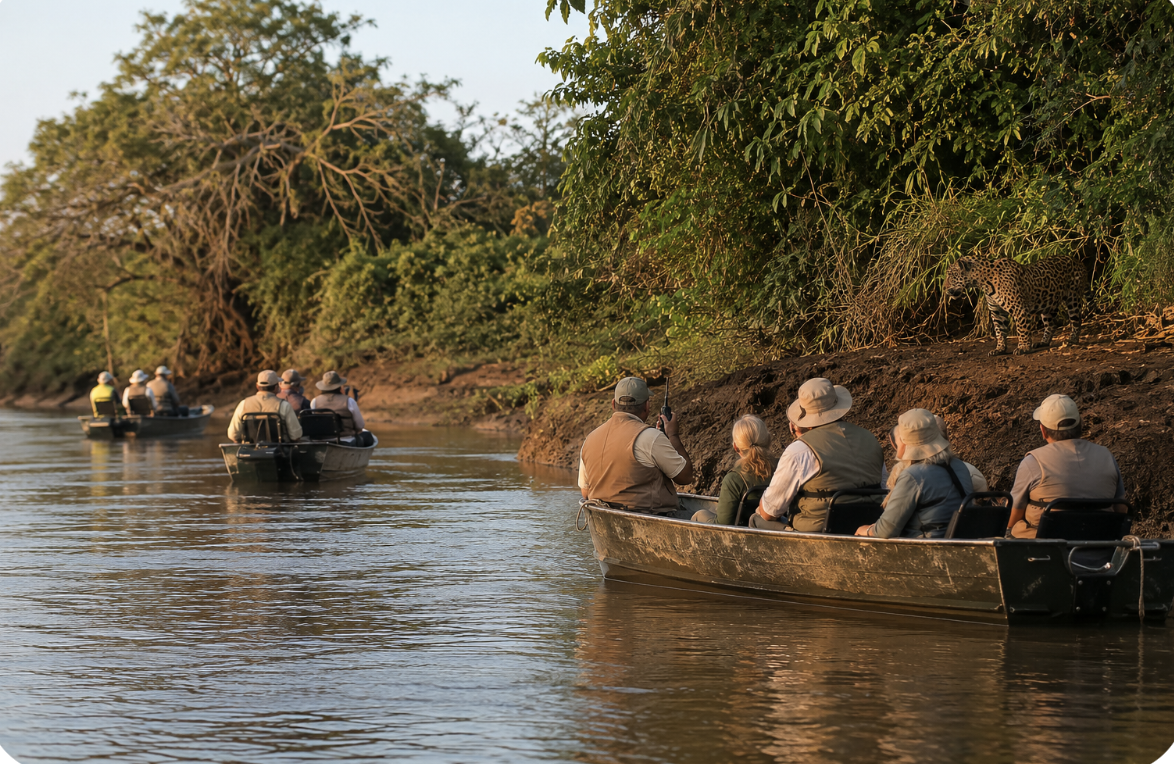
At first light on the Cuiaba River, a guide sees a jaguar on the bank. He must decide whether to radio the other boats. In high season, silence protects the sighting, the animal, and the business. That choice helps sustain a jaguar-viewing economy worth about US$6.8 million a year.
Wildlife ecotourism in Latin America and the Caribbean is no niche activity. In 2025, it was worth roughly US$15-30 billion a year and appears to be growing at about 10 percent annually. This blog asks what Guyana should learn from that record before the Rupununi scales further.
The stakes are local and immediate. The Rupununi already has wildlife, lodges, community monitoring, and a premium market. However, roads, air access, and rising demand can also bring crowds that degrade the very experience visitors pay for. The issue is not whether tourism will grow. The issue is whether Guyana will shape that growth before density, land conflict, and weak enforcement block better choices.
Density control protects the product.
Wildlife tourism sells encounters with animals in a limited space. When too many boats, people, or vehicles converge on a single animal, the quality of the encounter declines. Then the animal changes its behavior, and the business loses value.
Porto Joffre, in Brazil’s Pantanal, shows how this works. Local operators track sighting odds and boat density in real time. When jaguars become easy to find, operators stop broadcasting locations widely, because crowding lowers sighting quality and can stress the animals. That informal rule helped a recovered jaguar population support a major tourism market.
The Galapagos shows the same mechanism on a larger scale. About 700 certified guides enforce approach distances and feed information into a monitoring system and a guide-run app. That system helped protect viewing sites. However, it did not control the settlement boom that tourism financed on inhabited islands. The lesson is blunt: managing the encounter is important but insufficient if no one manages the wider growth around it.
Guyana already has pieces in place. Surama, Rewa, Caiman House, Wichabai, and Dadanawa support monitoring for fisheries, black caiman, turtles, forests, carbon, giant anteaters, and red siskins. Yet the country still lacks a visitor-density system for wildlife ecotourism at the corridor scale. That gap matters little while numbers stay low. It will matter a great deal once road access improves.
Local communities have the capacity for monitoring and research, but lack a broader context in which to work. The villages and ranches already run nascent monitoring systems for fisheries, caiman, turtles, forests, carbon, and species such as the giant anteater and red siskin. But as far as I know, there is no way to monitor what happens to wildlife when there are too many visitors, so that Guyana can measure but not yet act, and perhaps, given low visitation, it does not need to, yet.
Rules and tenure came first.
Many accounts credit state spending for ecotourism success. The stronger reading is narrower and more useful. States mattered first in wildlife ecotourism because they fixed tenure, drew exclusion boundaries, licensed use, and enforced rules. Those acts reduced the risk for private and community operators, allowing tourism to scale in a structured way without risks of ecological collapse.
The sequence repeats across the strongest cases. Ecuador created the Galapagos National Park in 1959, ending 127 years of extraction before ecotourism took off. Belize established protected areas such as Half Moon Caye in 1982 and Hol Chan in 1987 before marine tourism matured. Costa Rica built out its national park system from 1970, then later added a tourism incentive law, certification, and payments for ecosystem services.
Infrastructure came later, and often from the income tourism itself generated. The key early move was legal and regulatory, not fiscal. Protected status, zoning, licensing, guide systems, and fee rules created scarcity that operators could sell. Airports, roads, and lodges mattered, but they did not create the wildlife product on their own.
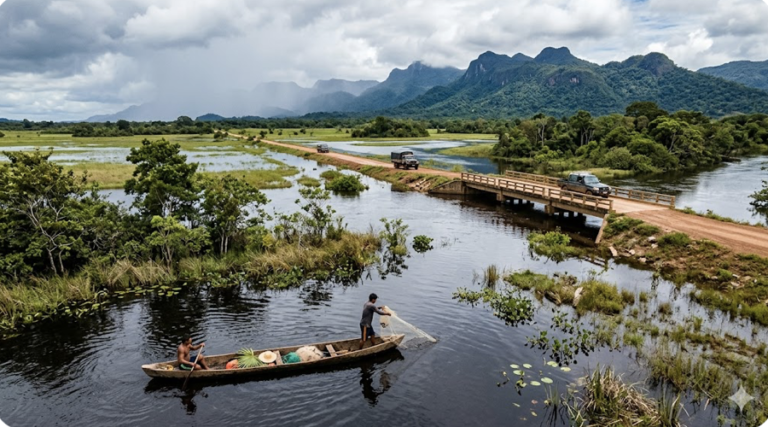
Guyana has moved partway through this same sequence. The Low Carbon Development Strategy 2030 (LCDS 2030) channels 15 percent of carbon-credit revenue to Amerindian village funds and supports land titling. Iwokrama gained legal status in 1996, and the Kanuku Mountains became a protected area in 2011. The Guyana Tourism Authority is also building guide training, licensing, and hospitality standards. However, these steps still do not add up to a corridor-wide tourism regime for the Rupununi.
Guyana has not finished the sequence.
The Rupununi already proves market potential. Karanambu, Rockview, Surama, Rewa, Caiman House, Dadanawa, Wichabai, Saddle Mountain, and Maipaima show that private and community operators can attract visitors before the state builds a complete system. Visitors also incur high daily costs to reach sites that remain basic in terms of service. That premium reflects rarity and remoteness. It will not survive unmanaged growth.
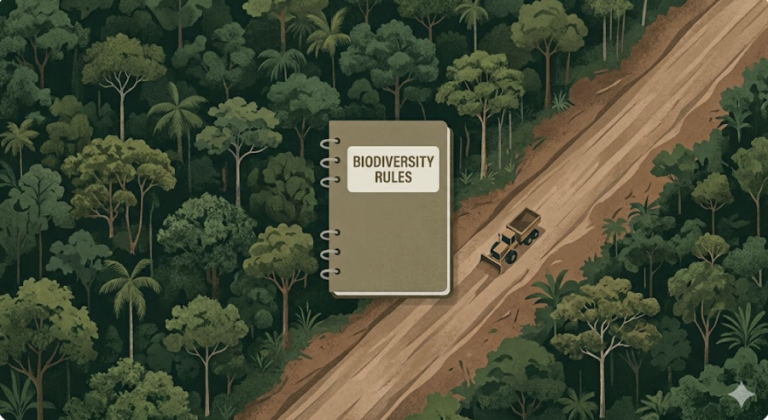
The bottleneck is not wildlife, local skill, or proof of demand. The bottleneck is public coordination at the scale the road will require. Guyana still lacks a clear plan for carrying capacity, site zoning, guide rules, settlement spillovers, and enforcement along the corridor. Without that plan, each lodge can manage its own patch, but no institution can manage the cumulative load.
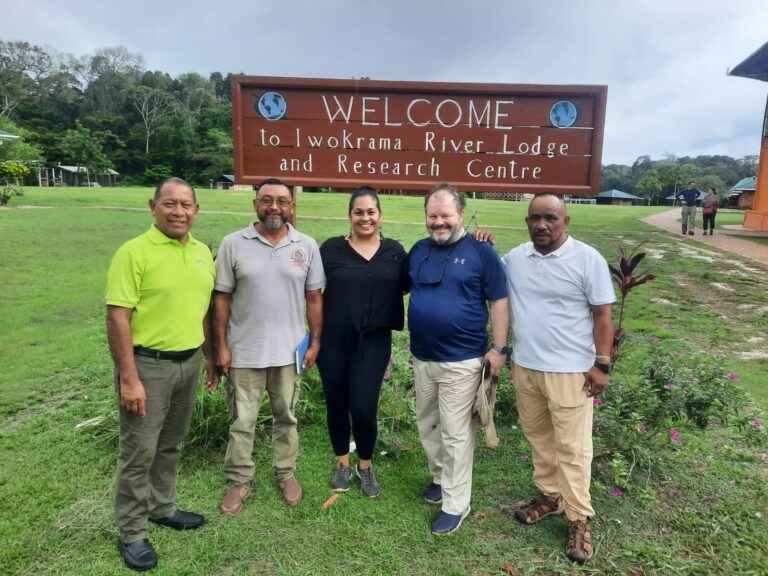
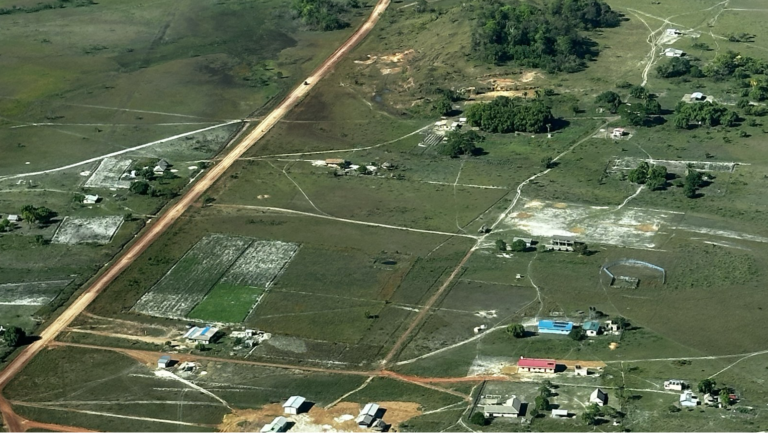
Surama captures the issue in one place. The village has real wildlife, local governance, and monitoring capacity. It sits inside a national system that remains incomplete. If Guyana wants a high-value, low-volume destination, it must build the missing public layer before the Georgetown-Lethem Road reaches full effect.
The forecast is conditional.
The Rupununi is still one of the least commercialized wildlife corridors in Latin America and the Caribbean. That gives Guyana an advantage. It can still decide who controls access, how many visitors’ sensitive sites can absorb, and how tourism revenue supports enforcement. However, this window will close as the Georgetown-Lethem Road improves and traffic rises.
The forecast has a clear test. Guyana must establish a national wildlife-guiding system and a corridor management regime before visitor numbers rise sharply. Miss either step, and the Rupununi will drift toward crowding, lower-quality encounters, and weaker price premiums. Build both, and Guyana can keep a high-value market that depends on scarcity rather than volume.
The work starts now. While Guyana expands air access and improves the road, it should draft carrying-capacity rules, visitor-management plans, and biosecurity measures sized for future traffic rather than today’s trickle. It should also market the Rupununi as a high-value, low-volume destination. That choice will limit numbers, but it will also protect the scarcity that gives the wildlife product its price.
The harder problems sit outside the viewing sites. Tourism growth also expands towns, waste, water demand, labor markets, and pressure on land. Galapagos shows one version of that wider load. Other African and Latin American cases show others. If Guyana plans only for lodges and sightings, it will miss the settlement and service pressures that often cause greater damage.
Two risks deserve close attention. First, enforcement capacity may remain too thin to make rules credible. Second, the oil economy may raise wage expectations faster than interior tourism can match them – a pattern observed in other countries. If either risk intensifies, guiding and ranger systems will be harder to staff where they matter most. Surama can measure its forests today. Governing tomorrow’s crowd will require a different institutionality, a different budget, and a different political choice. If Guyana funds that choice now, the Rupununi can keep its premium and its wildlife. If it waits, the road will set the pace, and the losses will be harder to reverse. For the governance and economic frameworks needed to manage this transition, see Guyana’s Oil Boom 2015 to Today at Watkins Advisory and Guyana Reforms 1991–1996 at The Next Wave.
Explore the Rupununi
Dive deeper into the Rupununi’s natural and human world. Explore the region’s ancient geology and Guiana Shield, the remarkable wildlife of the Rupununi, the rich history of human settlement, and the living culture of the people of the Rupununi. Learn more about the authors behind this companion site, and follow the latest thinking on conservation and development in the Rupununi Blog.
Follow the Rupununi on Facebook for new stories, wildlife news, and updates from the book: facebook.com/rupununi.org
Discover more from Rupununi: Rediscovering a Lost World
Subscribe to get the latest posts sent to your email.
One Comment