
The Well That Found Oil No One Could Sell.
Karanambu’s Karanambo-1 struck crude in 1982 and proved it worthless days later.
In 2025, geologist Ygor Sousa struck oil at 17 meters in the Rupununi, on the floodplain that gives Karanambu its name. Then two water wells 30 meters apart confirmed the find. He classified it as shallow migration and seepage, its commercial value highly speculative. That discovery reopens the blunt question for Karanambu and the wider Rupununi communities.
“Should Rupununi communities back development of the Takutu oil, or is the standing wetland worth more with the oil left in the ground?“
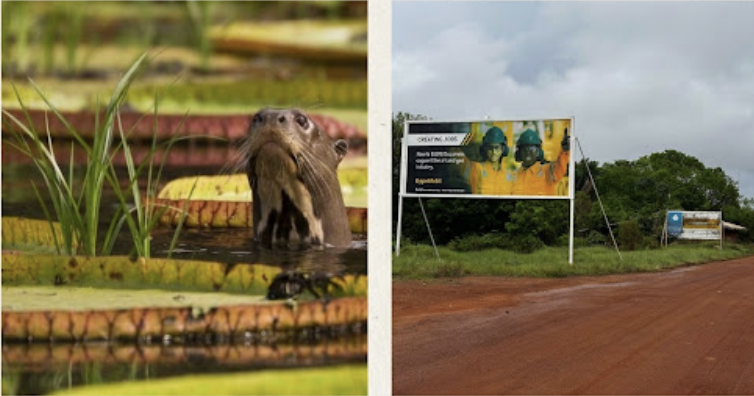
In 1982, Home Oil Company of Canada drilled Karanambo-1 and struck 42° API (American Petroleum Institute) sweet crude. During that test, the reservoir depleted, and the company abandoned the well as non-commercial. Karanambo-1 sits on the Rupununi floodplain and shares its name with Karanambu, the lodge in the Rupununi wetland where giant river otters have been core to an established ecotourism business.
This post makes three claims. First, Rupununi oil has never been commercial: five deep wells in forty-five years, five failures. Second, the people who live on the surface do not own or control the oil beneath it. Third, every comparable wetland that was drilled paid an environmental and social price. Karanambo-1 runs through all three — the well that found oil no one could sell.
Rupununi oil, including at Karanambu, has never paid in forty-five years of trying.
The Rupununi has hydrocarbons but has not produced a single commercial field. Five deep wells, five non-commercial results, across forty-five years. Karanambo-1, near Karanambu, flowed 400 barrels a day from fractured Lower Jurassic volcanic rock. Then its localized fracture network rapidly depleted. Geologists call this compartmentalization: the oil sits in isolated pockets rather than in a single connected pool. In 2010, Groundstar Resources and Canacol drilled Apoteri-K2 600 meters away, into the same rock, and so again failed to establish commercial flow.
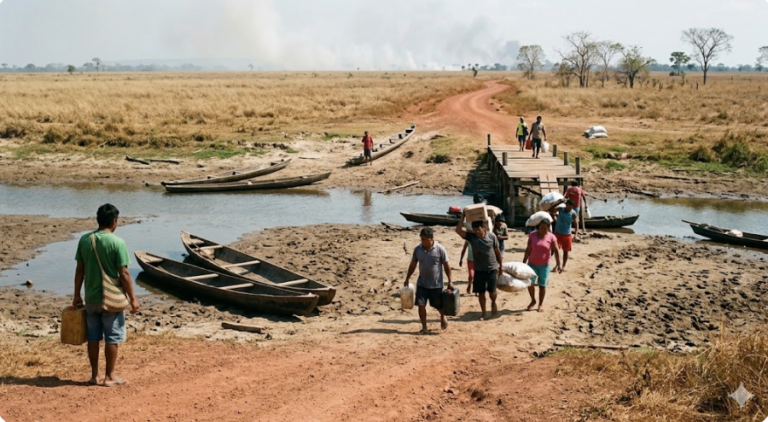
The danger runs the other way, through water. A near-surface spill in the May-to-September flood would travel throughout the wetland. The Rupununi Portal floods 3,095 square kilometers for an average of 49 consecutive days each year. Rivers rise and fall six meters, and the Ireng overtops its banks. As a result, that flood would carry a spill across the boundary between the Amazon and Essequibo basins.
The 2025 seepage shows the petroleum system still moves oil toward the surface. A minority of geologists argue untested fault blocks may hold un-depleted reservoirs, and OilNOW reports optimistic estimates of oil yet to be found. Still, those claims leave recoverability unsettled rather than disproven; none describes commercial oil. Some new technologies, including horizontal drilling, branching wells, hydraulic fracturing, and acidizing, could also make Rupununi oil more commercially viable.
The people living on the surface do not own the oil beneath it.
The Petroleum (Production) Act of 1939 vests all petroleum in the State, a principle carried over into the Petroleum Activities Act of 2023. Likewise, the Mining Act of 1989 does the same for minerals. The Amerindian Act of 2006, meanwhile, grants titled communities the surface and withholds everything below it.
An oil concession might repeat what we have seen in the gold sector. Sections 48 and 50 of the Amerindian Act govern consent for small and medium mining, not petroleum. Section 48 requires two-thirds of the Village Council to agree; Section 50 allows the Minister to override that refusal on public-interest grounds. The consent process for a Takutu oil concession under the 2023 Act is not well described beyond the provisions of the Environmental Protection Act[1].
Marudi shows the state consults after making a decision.
Marudi Mountain shows how the gold consent sequence ran. It is a South Rupununi site near Aishalton. In late 2021, the government approved an expansion agreement with Aurous Mining, the Rupununi Miners Association, and Romanex before consulting the Wapichan. The South Rupununi District Council (SRDC) objected on 19 November 2021. On 2 December 2021, the government granted a three-year license to Golden Shield Resources anyway and then consulted afterward.
Marudi’s water reached a turbidity of 824 nephelometric turbidity units (NTU) in 2016, with mercury at 4.55 and 4.64 micrograms per liter. At nearby Parabara, every adult tested carried hair mercury above the high-exposure threshold, averaging 27.62 micrograms per gram. Women of childbearing age averaged 28.65, more than tenfold the World Health Organization (WHO) and Food and Agriculture Organization (FAO) limit. Exposure tracked fish consumption. These are gold-sector outcomes, not oil outcomes. They show a regime that fails to protect people, because authority sits in Georgetown, far from the damage it permits.
Most oil extraction cases in tropical wetlands went wrong.
Oil extraction in the Ecuadorian Yasuní, the Peruvian Amazon, the Niger Delta, the Louisiana wetlands, and the Athabasca peatlands all failed socially and environmentally. These five are not a hand-picked set of disasters; they are the population that matters — the wetlands where drilling went ahead.
The case that would cut the other way does not exist: no tropical wetland has hosted a commercial oil field for decades with its fish, water links, and Indigenous livelihoods left unharmed. The Rupununi, including the Karanambu floodplain, worsens the odds: legal authority sits in Georgetown while only the Indigenous communities can monitor the ground.
All five comparator cases show material social and environmental impairment. The Trans-Ecuadorian Pipeline System (SOTE) leaked 16.8 million gallons between 1972 and 1992. Similarly, Peru recorded 474 oil spills between 2000 and 2019. The Niger Delta collapsed, Louisiana’s marshes subsided two- to threefold, and Athabasca lost its peatlands to bitumen.
Existing extraction in the Rupununi brings its own toll. On 1 June 2018, a miner’s excavator destroyed a bridge on the Lethem-to-South-Rupununi Road, and no one paid to rebuild it. The Aishalton hospital absorbs the health burden, and while mining income drains into the camps, it does not reach the communities. The one promised upside of oil, cheap fuel for Lethem, appears in the Canacol proposal and the risk assessment. Yet it has not arrived in forty-five years.
The Okavango and Yasuní were partly spared by dry holes and activism, not by clean drilling.
In Namibia’s Kavango Basin, ReconAfrica drilled three wells: Kawe 6-2, Mbambi 6-1, and Makandina. All three failed to establish commercial oil, and operations paused in 2023 under community and legal pressure. The International Union for Conservation of Nature (IUCN) passed Motion 136 in 2021. The United Nations Educational, Scientific and Cultural Organization (UNESCO) also recorded concern. But the dry holes stopped operations.
Yasuní shows a national vote did not stop the drills.
Ecuador tried another route and held a national vote on whether to open the Yasuní. On 20 August 2023, 58.95 percent chose to keep Block 43 oil underground. A Constitutional Court deadline and a 2025 ruling by the Inter-American Court of Human Rights made compliance compulsory. Yet in May 2025, Petroecuador still pumped 43,678 barrels a day.
Drilling began in Block 43 in 2016. Since then, the wells have caused repeated spills, fouling land and water. Service roads and platforms have cut into the 1,022,736-hectare biosphere reserve. Forest loss within the block rose from under 8 hectares in 2012 to 77 hectares by 2016 and to roughly 300 hectares by 2022. The loss eroded one of the most biodiverse areas on the planet.
In addition, the footprint threatens the uncontacted Tagaeri and Taromenane and has divided Waorani communities. Even after the referendum and the court ruling, only 10 of 247 wells have been shut.
The Rupununi Wetlands, including the Karanambu floodplain, stand today for the same reason as the Okavango. The oil beneath them proved non-commercial, so no one came to drill. No institution protected that floodplain; the geology did.
The record points one way for Karanambu and the Rupununi: leave the oil down.
After forty-five years of drilling, the Rupununi shows no commercial return. Every comparable wetland-oil case shows environmental and social harm.
The Rupununi Wetlands feed local communities: more than 450 fish species, cross-basin exchange that peaks with the flood, and 3,095 square kilometers of seasonal water. Region 9 communities have earned an estimated US$11 million to US$13 million in carbon revenues from the Low Carbon Development Strategy (LCDS). They are on track to earn US$28 million to US$31 million. Tourism revenue is hard to measure. But the Rupununi has more than a dozen ecotourism lodges, community-owned or employing residents directly.
The decision on oil is not that of individuals or single communities. Instead, any extraction will affect the whole wetland and all communities. The 2016 Marudi mediation recorded that the project never properly consulted the wider Wapichan public. The SRDC and the North Rupununi District Development Board (NRDDB) speak for the region. Any oil decision must, at a minimum, include them.
The decision is not individual, and it is not urgent. Forty-five years of dry wells bought the Rupununi time; the LCDS carbon revenue and the ecotourism lodges, including at Karanambu, are already paying. Leave the Takutu oil where it is and let the SRDC and the NRDDB decide on any changes to it.
[1] This summary is general orientation, not legal advice; seek Guyanese counsel first. The Amerindian Act 2006 (ss. 48–53) lets a Village veto small- and medium-scale mining on titled land by two-thirds vote, but leaves the Minister a “public interest” override for large-scale mining (s. 50). The Petroleum (Production) Act 1939 and Petroleum Activities Act 2023 vest petroleum in the State, and the 2023 Act contains no free, prior and informed consent (FPIC) requirement for concessions on or near Amerindian lands; the Mining Act 1989 does not apply to petroleum. The only formal touchpoint for oil is the Environmental Protection Act 1996 EIA process—consultation, not consent, and not clearly triggered for untitled or contiguous communities. Guyana has not ratified ILO Convention 169, and UN CERD has urged it to embed FPIC by amending the Amerindian Act.
Follow the Rupununi on Facebook for new stories, wildlife news, and updates from the book: facebook.com/rupununi.org
Discover more from Rupununi: Rediscovering a Lost World
Subscribe to get the latest posts sent to your email.

One Comment